Infrastructure

The machines, plant and test equipment behind every Diameter Casting product.

Stage 1

Pattern Making

In-house pattern making for accurate, repeatable castings.

In-house pattern shop

An in-house pattern shop lets us make and revise patterns without waiting for outside suppliers, which shortens lead times and keeps casting dimensions stable.

  • Semi-equipped in-house pattern shop
  • Patterns made, modified and repaired on site
  • Shortens lead times for new designs
  • Keeps dimensions consistent batch to batch
Pattern materials (aluminium / cast iron / wood)

Pattern material is chosen to match the job: wood for short runs, aluminium for everyday production and cast iron where tooling life matters most.

  • Wood patterns for low-volume and prototype work
  • Aluminium patterns for general production runs
  • Cast iron patterns for high-volume, long-life tooling
  • Outsourced pattern making available for specialist requirements

Stage 2

Sand Preparation

Consistent sand quality is the foundation of a defect-free mould.

Sand plant / mullers

The sand plant conditions moulding sand to the correct strength, moisture and permeability for each process. Separate plants for machine and hand moulding keep sand parameters optimised for each line.

Capacity
30 MT per hour
  • Semi-automatic sand plant, 300 MT per hour
  • Separate plants for machine moulding and hand moulding
  • Processes silica sand, chromite sand and yellow sand
  • CO₂, green sand and resin sand systems
  • Multiple mullers, 200–500 kg capacity each
  • Integrated dust extraction system

Sand reclamation unit

Used moulding sand is reclaimed rather than discarded. The unit crushes, cools and screens spent sand so it can be returned to the system with consistent properties.

  • Sand crushing with integrated dust collector
  • Cools, screens and cleans used moulding sand
  • Reclaimed sand returned to the production cycle
  • Reduces waste and keeps sand quality consistent

Sand mixers (no-bake)

No-bake sand mixers blend sand with chemical binders to produce strong, accurate moulds that cure at room temperature — suited to the larger covers and frames in the product range.

  • No-bake (resin) sand mixing system
  • Blends sand with chemical binders for cold-setting moulds
  • Suitable for larger and more complex mould shapes
  • Good dimensional stability without heat curing

Stage 3

Moulding

Multiple moulding methods to handle every size and volume.

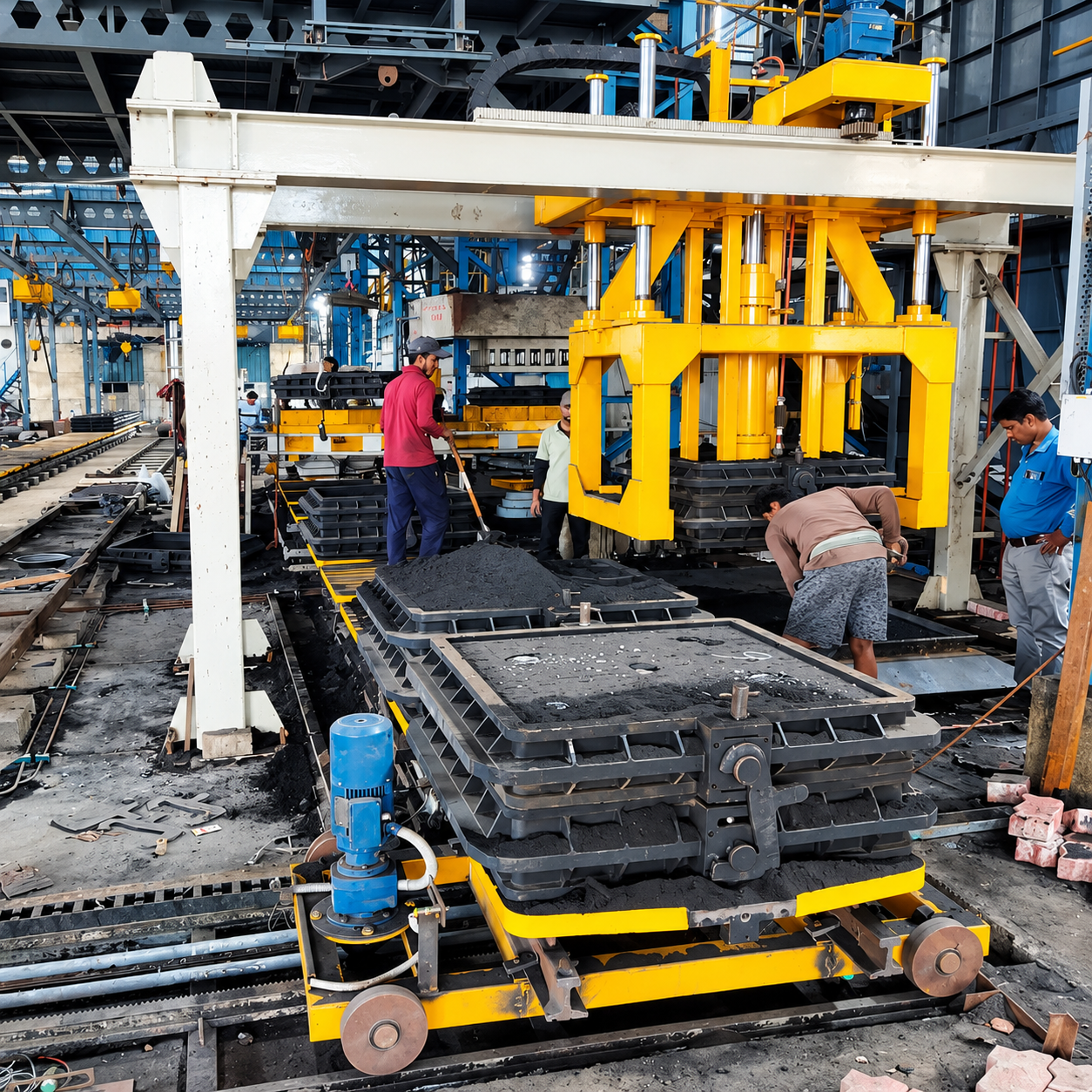
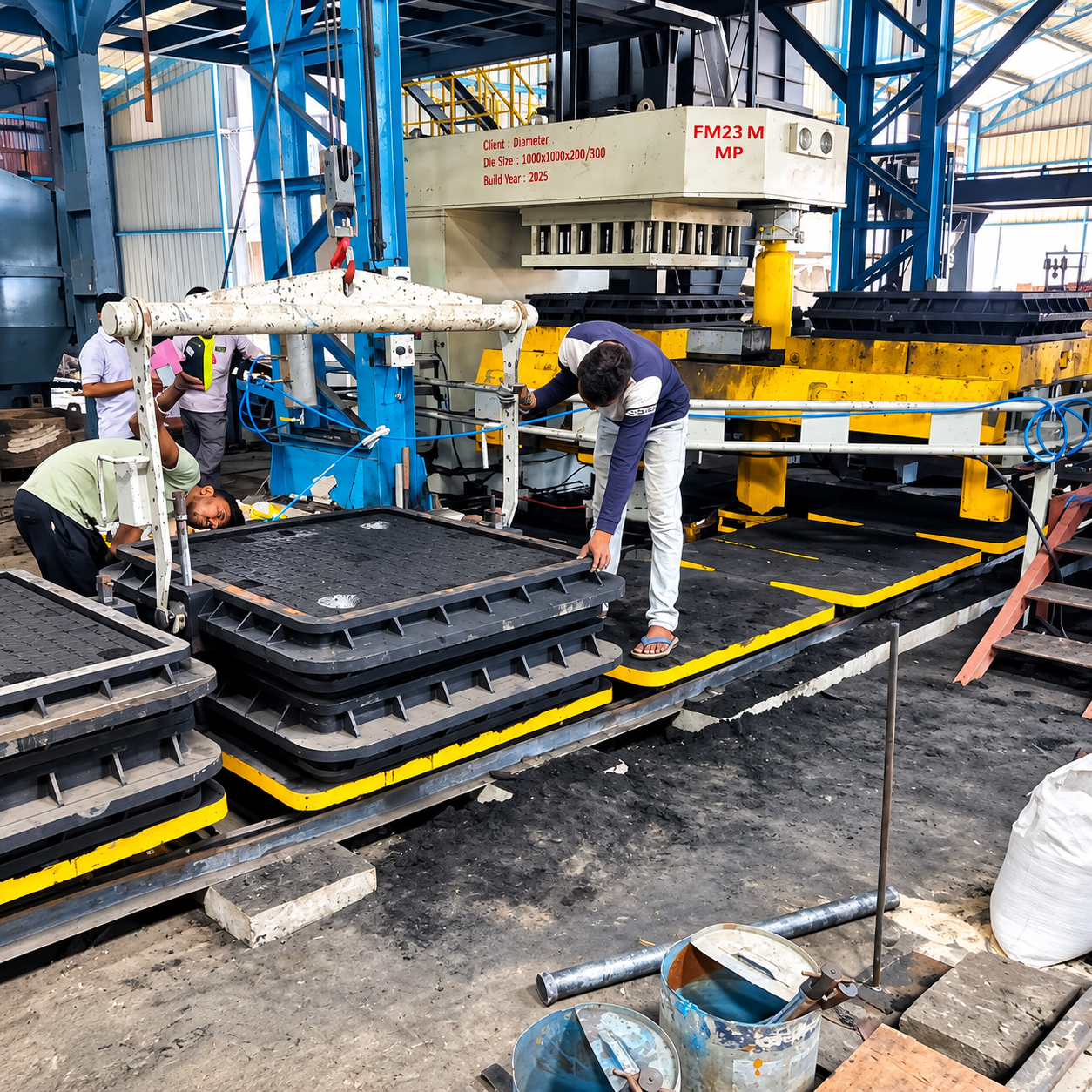
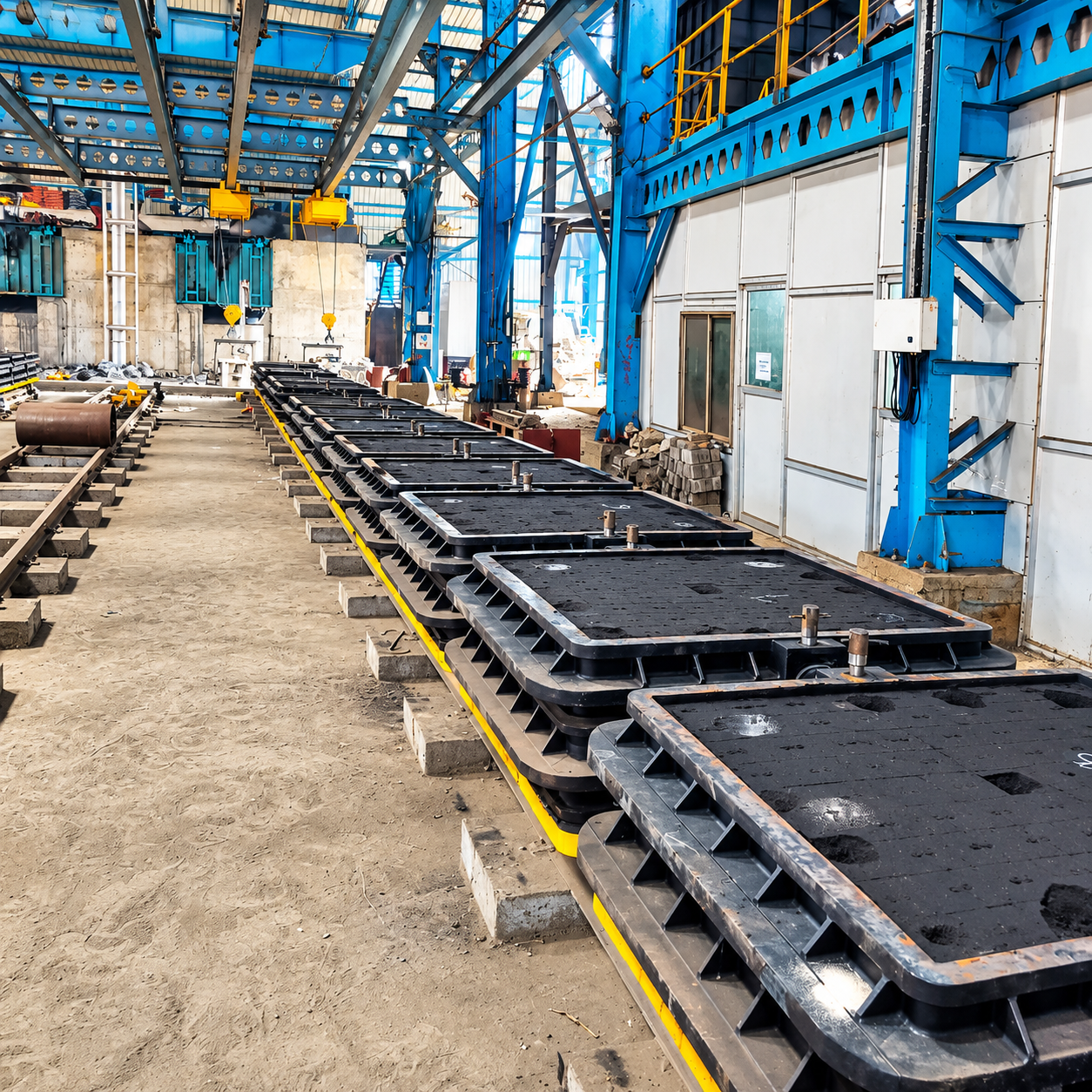
High-pressure moulding line

The Savelli high-pressure line compacts sand under controlled pressure to produce dense, dimensionally accurate moulds at a steady production rate.

Make / model
Savelli
Capacity
Box size 1100 × 1100 mm
  • Savelli high-pressure moulding facility
  • Box size: 1100 × 1100 mm
  • High compaction pressure for dense, accurate moulds
  • Consistent surface finish and tight dimensional control
  • Suited to medium and large manhole covers and frames

Semi-automatic moulding

The ARPA 450 semi-automatic machines combine machine compaction with operator control, allowing pattern changes without a long changeover and handling a wide range of standard sizes.

Make / model
ARPA 450
Capacity
Box size 680 × 730 mm
  • ARPA 450 (one pair)
  • Box size: 680 × 730 mm
  • Machine compaction with operator control
  • Fast pattern changeover for medium batch sizes
  • Suitable for standard cover and frame sizes

Hand moulding line (larger castings)

Larger or non-standard castings that do not suit machine moulding are handled by skilled hand moulders on a dedicated floor moulding line.

  • Dedicated floor moulding area for large and heavy castings
  • Skilled hand moulders for complex or non-standard shapes
  • Flexible for special sizes and low-volume orders
  • Complementary to the machine moulding lines

Stage 4

Core Making

Precision cores for internal cavities and recesses in every casting.

Core making machines

Cores are made using CO₂, resin or phenolic urethane no-bake systems to produce accurate internal features in covers and frames.

  • CO₂ / resin / phenolic urethane no-bake core systems
  • Produces cores for internal cavities and recesses
  • Consistent core strength and dimensional accuracy
  • Supports the full range of cover and frame designs

Stage 5

Melting & Pouring

Controlled melting and pouring for consistent iron grades.

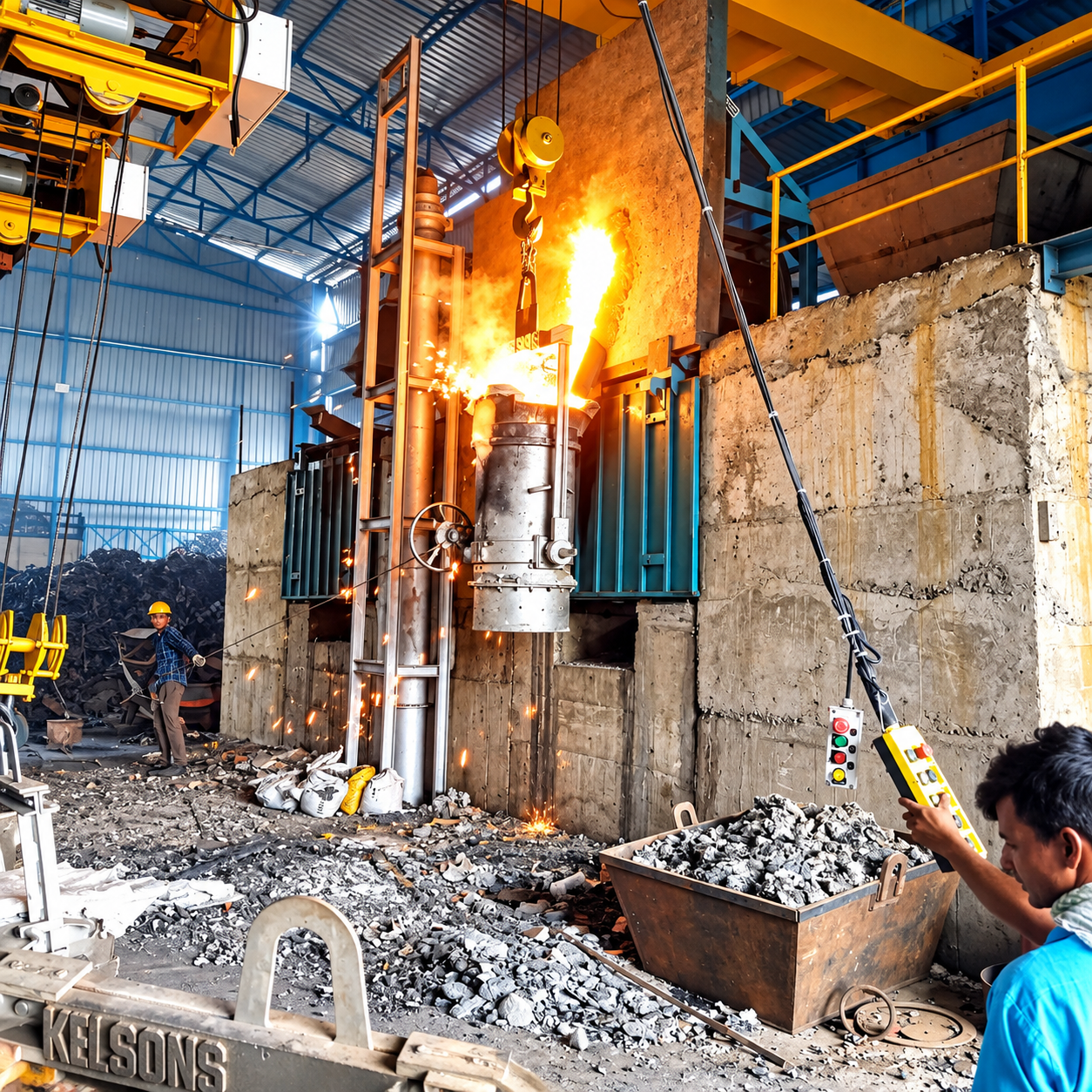
Induction furnace

Induction furnaces provide precise temperature and chemistry control for both cast iron and ductile iron melts. A 750 KW unit with two 1.0 MT crucibles handles main production; a 350 KW unit handles secondary melting.

Capacity
1.0 MT per heat (× 2 crucibles)
  • 650 KW induction furnace
  • 2 crucibles, 1.0 MT capacity each
  • Additional 350 KW induction furnace, 500 kg crucible
  • Close control of melt temperature and chemistry
  • Suitable for cast iron and ductile iron grades
  • Chemistry checked by spectrometer before pouring

Cupola furnace

The cupola furnace provides continuous high-volume iron melting at 5.0 MT per hour, complementing the induction furnaces for sustained production output.

Capacity
5.0 MT per hour
  • Cupola furnace, 5.0 MT per hour melting rate
  • Continuous iron melting for high-volume grey iron production
  • Fed with pig iron, returns and scrap
  • Complements induction furnace capacity

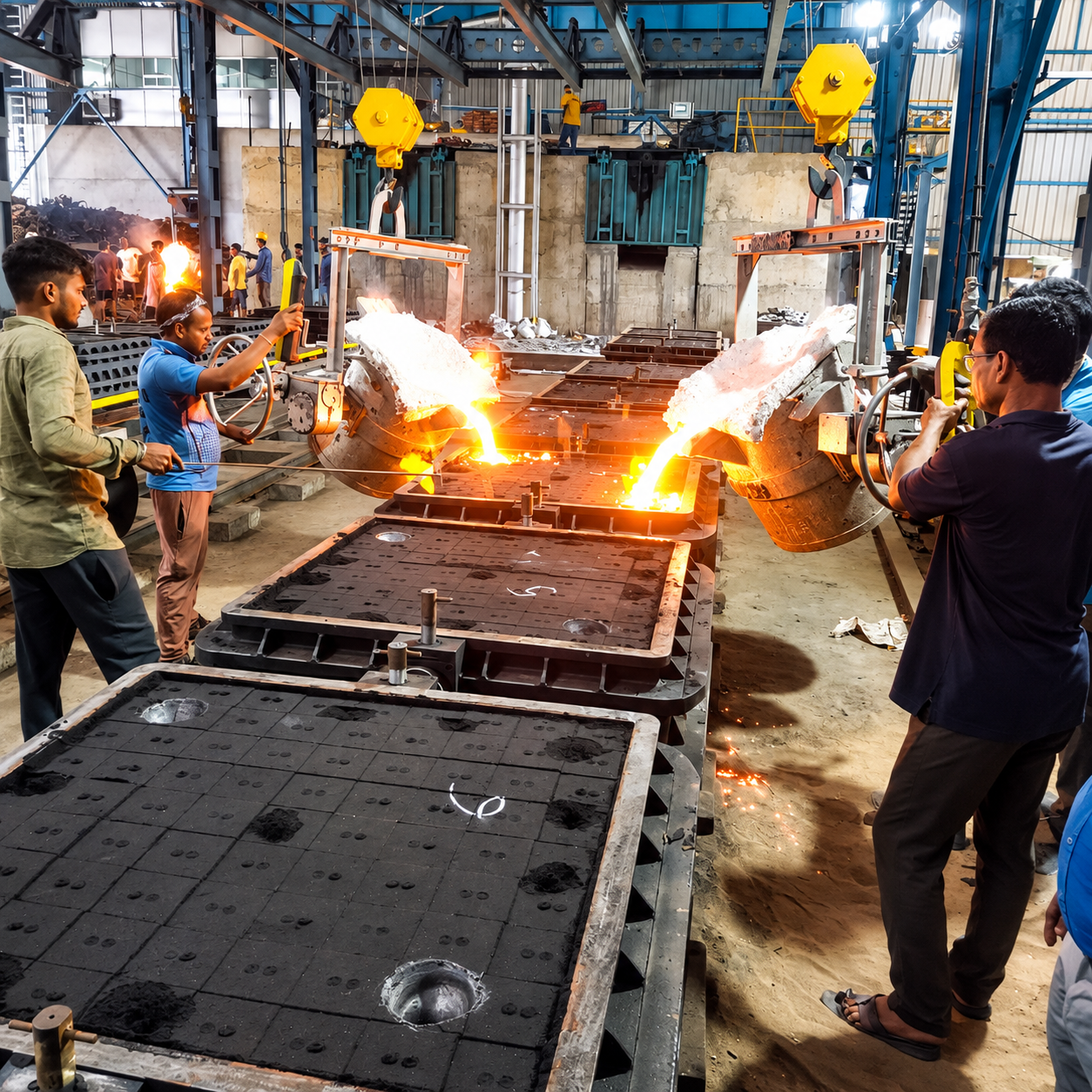
Ladles and pouring

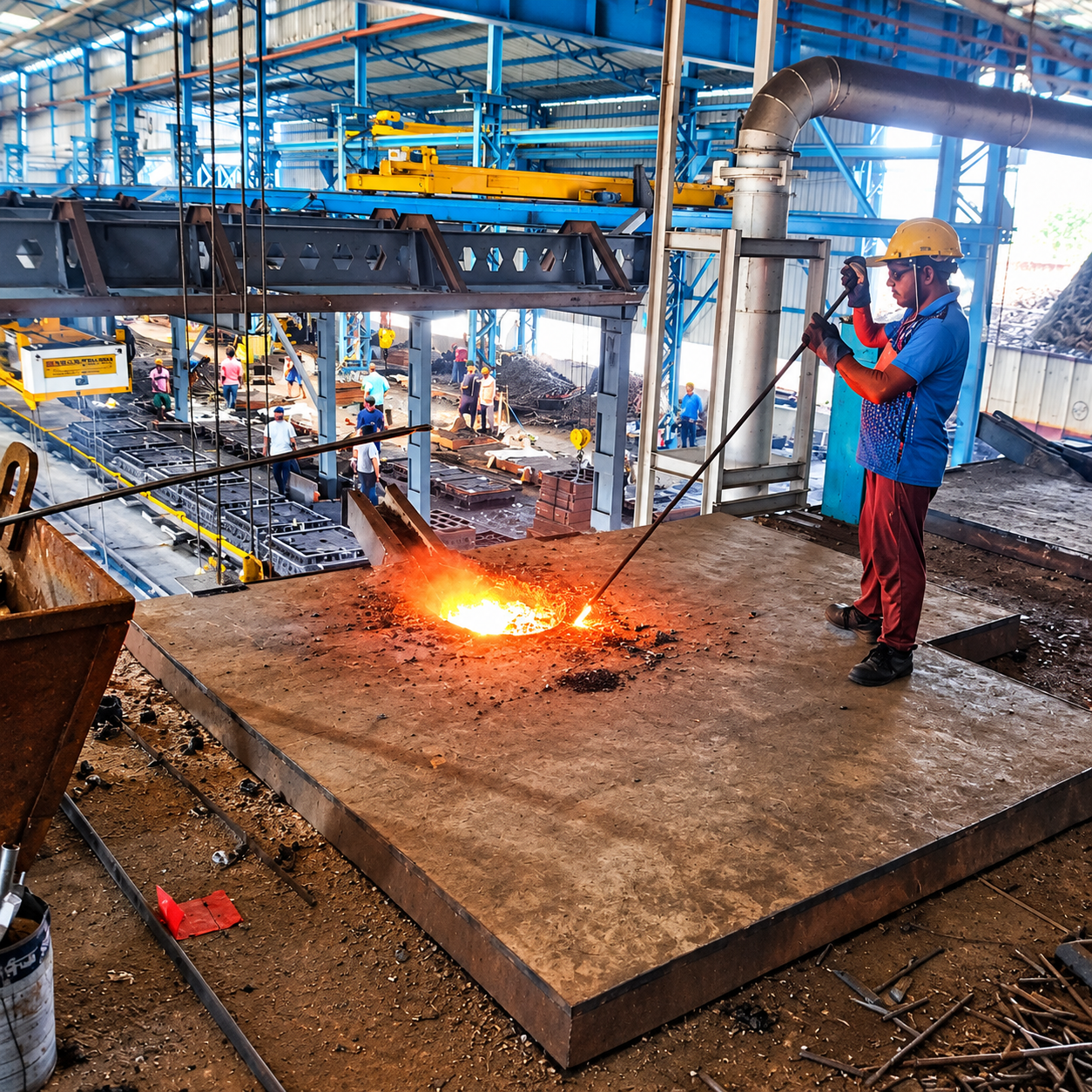
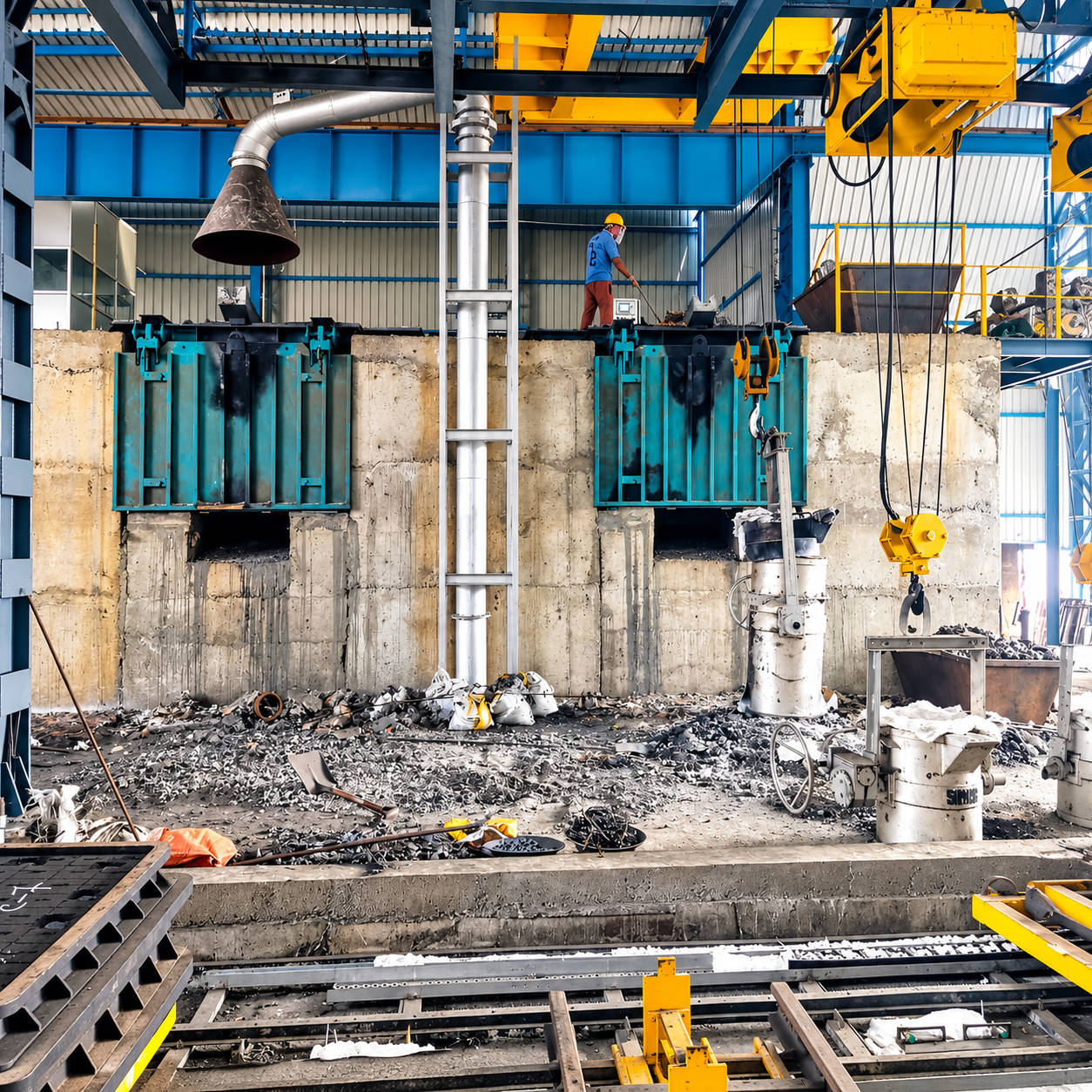
Molten metal is transferred in preheated ladles and poured at a controlled temperature and rate to minimise casting defects.

  • Preheated transfer and pouring ladles
  • Controlled pour temperature and speed
  • Minimises cold shuts, gas porosity and shrinkage defects
  • Handled by EOT crane and monorail

Stage 6

Fettling & Finishing

Clean, accurate finishing for every cover and frame before inspection.

Shot blasting machine

Shot blasting removes sand, scale and surface irregularities from every casting, leaving a clean, uniform surface ready for inspection and coating.

  • Steel shot blasting for sand and scale removal
  • Uniform, clean surface on all castings
  • Prepares castings for inspection, machining and coating
  • Hand fettling and grinding complement the blast process

Grinding stations

Grinding stations remove gates, risers and flash, and dress the seating faces of covers and frames to the correct profile.

  • Hand fettling and angle grinding stations
  • Removes gates, risers and parting-line flash
  • Correct seating faces for frames and covers
  • Checked dimensionally after grinding

Cutting and welding

ARC and gas cutting equipment removes heavy gating; welding is available for approved repairs where the product specification permits.

  • ARC and gas cutting equipment
  • Welding machines for approved repair work
  • Removes heavy gating and risers cleanly
  • Welded repairs carried out only where specifications allow

Stage 7

Testing & Quality Control

In-house testing at every stage, from melt chemistry to proof load.

Spectrometer (chemical analysis)

The Spectromax spectrometer analyses melt chemistry in minutes before each pour, confirming the iron meets the required grade and logging results for traceability.

Make / model
Spectromax
  • Spectromax optical emission spectrometer
  • Analyses melt chemistry in minutes before pouring
  • Covers all key elements: C, Si, Mn, S, P, Mg and others
  • Ensures iron meets the required grade (grey or ductile)
  • Results logged for traceability

Load testing machine

The load testing machine applies a controlled hydraulic force to verify that finished covers and frames meet the proof load required by EN 124 — from A15 up to D400 — without leaving the plant.

Capacity
Up to 50 tonnes (500 kN)
  • Hydraulic load testing machine, up to 50 tonnes (500 kN)
  • Verifies proof load to EN 124 classes A15 through D400
  • In-house testing — no third-party lab required for routine checks
  • Test results recorded and available on request
  • Heavier load classes tested at an approved external laboratory

Hardness tester

Hardness testing is applied to samples from each batch as a quick check that material properties are consistent with the melt chemistry and heat treatment.

  • Brinell / Rockwell hardness testing
  • Checks surface hardness as an indicator of material consistency
  • Applied to samples from each production batch
  • Results recorded alongside melt and load test data

Metallurgical laboratory

The metallurgical laboratory examines microstructure and mechanical properties, confirming that castings meet their grade and providing records for export quality documentation.

  • Microstructure examination (graphite form, matrix)
  • Tensile strength and elongation measurement
  • Confirms grey iron and ductile iron grade compliance
  • Supports traceable quality records for export documentation

Sand testing laboratory

Sand is tested regularly for moisture, strength and permeability. Results feed back to the sand plant to keep parameters within limits and prevent mould-related defects.

  • Regular testing of moulding sand parameters
  • Moisture, green strength, permeability and grain size
  • Results used to adjust the sand plant in real time
  • Helps prevent mould-related casting defects

Stage 8

Coating, Packing & Dispatch

Protected, palletised and loaded for safe delivery to any destination.

Coating / painting area

Finished castings are coated with bituminous or other protective paint in a dedicated area after shot blasting and inspection, ready for packing and dispatch.

  • Bituminous or protective paint coating
  • Applied after shot blasting and final inspection
  • Dedicated area for clean, even coverage
  • Coating thickness checked before dispatch

Packing and container loading

Castings are palletised or crated and loaded into containers for export. Packing is designed to keep products secure in transit and compliant with export documentation requirements.

  • Pallet and crate packing for domestic and export shipments
  • Container loading for FCL and LCL export orders
  • Products secured to prevent movement in transit
  • Packing documentation prepared for export clearance

Stage 9

Material Handling

Safe movement of heavy moulds, ladles and finished castings.

EOT crane

A 5-tonne electric overhead travelling crane handles the safe movement of heavy moulds, ladles and finished castings across the main production floor.

Capacity
5 tonne
  • 5 tonne electric overhead travelling crane
  • Covers the main shop floor area
  • Used for moving moulds, ladles and finished castings
  • Safe rated lift for all production loads

EOT monorail

A 5-tonne monorail hoist moves loads along a fixed overhead track, linking workstations and the pouring area without using floor space.

Capacity
5 tonne
  • 5 tonne EOT monorail hoist
  • Fixed overhead track between workstations and pouring area
  • Saves floor space compared to ground-level transport
  • Speeds up movement of mid-weight loads

Fork lift

Fork lifts move pallets, finished castings and raw materials around the plant and into containers for dispatch.

  • Fork lift truck for internal and dispatch movement
  • Moves finished castings, pallets and raw materials
  • Used for container loading and yard operations
  • Complements overhead crane handling

Stage 10

Power & Utilities

Reliable power and services keep production running without interruption.

Transformer and power supply

A dedicated transformer provides stable high-voltage power to the induction furnaces and production machinery, sized for full simultaneous load.

  • Dedicated transformer for stable high-voltage supply
  • Powers induction furnaces and heavy machinery
  • Sized for full production load
  • Backed by VCB switchgear panel

Air compressor

The compressed air system supplies moulding rammers, core making equipment, cleaning tools and other pneumatic equipment across the plant.

  • Compressed air supply for the whole plant
  • Powers moulding rammers, core making, cleaning and hand tools
  • Receiver sized for continuous production demand
  • Pressure monitored and regulated at point of use

Cooling tower

The cooling tower removes heat from the furnace and equipment cooling circuits so that water can be recirculated rather than discharged.

  • Removes heat from furnace and equipment cooling circuits
  • Allows cooling water to be recirculated
  • Protects furnace coils and hydraulic equipment from overheating
  • Supports efficient water use

VCB / switchgear panel

Vacuum circuit breaker panels switch and protect the plant's high-voltage supply, providing fast fault isolation and reliable electrical distribution.

  • Vacuum circuit breaker (VCB) panels
  • Switches and protects the high-voltage distribution network
  • Feeds induction furnaces and main production machinery
  • Fast fault isolation for safe, reliable operation

Stage 11

Environment & Safety

Dust control and safe working conditions across the plant.

Dust extraction / pollution control

Dust extraction and filtration systems capture dust and fumes at sand handling, melting and finishing points, keeping the working environment safe and supporting environmental compliance.

  • Extensive dust extraction and pollution control system
  • Captures dust and fumes from sand handling, melting and finishing
  • Bag filter and cyclone systems at key emission points
  • Compliant with environmental norms
  • Contributes to a safe working environment

Around the plant

Ready to request a quote?

Tell us the product codes, quantities and destination and we will take it from there.